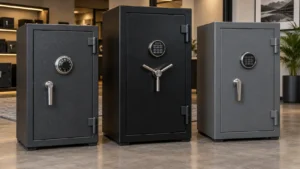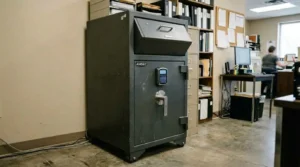
Businesses that handle cash throughout the day face a practical security problem. Employees need somewhere to place money quickly but opening the main safe door every time a deposit is made creates unnecessary access to everything already stored inside.
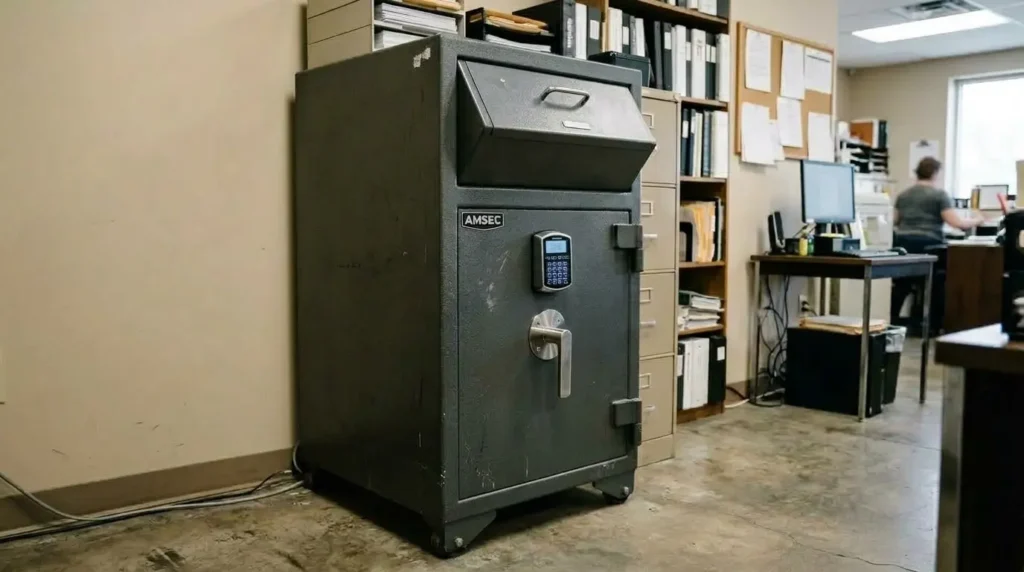
A depository safe solves that problem with a one-way deposit system. Cash, envelopes, checks, receipts, and other small items can be placed through a slot, drawer, or hopper without opening the main safe compartment.
Once the deposit passes through the mechanism, it falls into the secured area below and normally cannot be retrieved until an authorized person unlocks the safe.
What Is a Depository Safe?
A depository safe, sometimes called a drop safe, is a commercial safe built for repeated deposits during normal business operations.
Unlike a standard safe, the main door does not need to be opened every time something is placed inside. Employees can deposit cash while access to accumulated funds remains restricted to managers, owners, armored transport personnel, or other authorized users.
This makes the design useful anywhere several people handle cash, but only a smaller number should be able to remove it.
Typical Deposits Include
- Cash
- Checks
- Deposit envelopes
- Receipts
- Coin bags
- Small financial documents
- Cash-register till contents
Depository safes are therefore common in businesses that collect money throughout the day and want it removed from registers or counters as soon as possible.
How Does a Depository Safe Work?
The process is simple for the person making the deposit, but the internal design is more involved.
Step 1: The Deposit Enters Through a Slot or Hopper
The user places the cash or envelope into the deposit opening.
Depending on the safe, this may be:
- A narrow slot
- A front-loading hopper
- A top-loading hopper
- A rotary-style deposit mechanism
- A rear or through-wall chute
The employee does not need the main safe combination to make the deposit.
Step 2: The Deposit Passes Through the Internal Chute
After the hopper closes or the item is pushed through, gravity carries the deposit toward the secured compartment.
The chute is constructed so items can travel in one direction while making retrieval through the same opening much harder.
Step 3: Anti-Fishing Protection Blocks Retrieval
Many commercial deposit safes contain internal anti-fishing baffles.
These steel barriers allow deposits to fall into the safe while interfering with attempts to pull them back through the opening with wire, hooks, adhesive tools, or similar objects.
American Security depository models, for example, use dual anti-fish baffles in their hopper designs.
Step 4: The Deposit Reaches the Locked Compartment
Once the envelope or cash clears the deposit mechanism, it falls into the secure storage area.
The person making the deposit cannot simply reach back through the opening to retrieve it.
Removing the contents requires access through the safe door using the authorized lock.
Why Not Use a Standard Safe for Daily Cash Deposits?
A traditional safe can secure cash, but it usually requires the door to be opened before money can be placed inside.
That creates a different access problem.
Imagine a store where eight employees take turns closing registers. If each employee needs the safe combination simply to drop in a cash envelope, all eight may gain access to the money already stored inside.
With a depository safe, employees can deposit funds while the withdrawal side remains restricted.
The Main Difference
Standard safe
The user normally opens the secure compartment to place items inside.
Depository safe
The user can place items into the secure compartment without opening the main door.
That separation between deposit access and withdrawal access is the main reason businesses choose to drop safes.
Who Typically Uses Depository Safes?
A deposit safe is most useful where cash or financial documents need to be secured several times throughout the business day.
- Retail Stores
Cash can be transferred from registers into the safe instead of allowing large amounts to remain at the checkout counter.
- Restaurants and Bars
Managers and staff may deposit cash envelopes or till contents during shifts while limiting access to accumulated funds.
- Convenience Stores and Gas Stations
Frequent deposits can reduce the amount of cash kept in the register.
- Supermarkets
Multiple cashiers can make deposits without receiving access to the safe’s main compartment.
- Hotels
Depository safes may be used for shift deposits, receipts, or other controlled financial items.
- Offices and Service Businesses
Any business collecting cash, checks, or payment envelopes may use a deposit safe to separate collection from retrieval.
The right model depends on transaction volume, deposit size, employee access, available space, and how often the safe is emptied.
Front-Load vs Top-Load Depository Safes
Depository safes come in several physical configurations.
The opening location affects both placement and daily use.
Front-Load Depository Safe
A front-load safe places the deposit hopper or slot on the front of the unit.
This can work well when the safe sits beneath a counter or in another area where users approach it from the front.
For example, one AMSEC front-loading depository model uses a compact 14-inch-wide body and offers several lock options, including electronic and mechanical configurations.
Top-Load Depository Safe
A top-load model accepts deposits from above.
This configuration can work when the safe is positioned below a counter opening or where vertical access is more convenient than front access.
The better option depends on where the safe will be installed and how staff will approach it during a normal shift.
What Is a Through-Wall Depository Safe?
Some deposit systems allow items to be deposited from one side of a wall while the secure safe compartment remains on the other side.
These systems can be useful when staff need to make deposits without entering the room where the main safe door is located.
A through-wall configuration normally uses an adjustable chute connecting the deposit point to the protected compartment.
Manufacturer designs may also include anti-fishing barriers inside the chute to prevent items from being pulled back toward the deposit opening.
This type of arrangement requires careful installation because wall thickness, chute position, security, and safe anchoring all affect how the system operates.
Anti-Fishing Baffles Are an Important Security Feature
The deposit opening creates a necessary path into the safe, so manufacturers have to make that same path difficult to use in reverse.
That is the purpose of anti-fishing construction.
How Anti-Fishing Protection Helps
After an envelope drops through the chute:
- The deposit moves past internal barriers.
- The barriers prevent a straight path back toward the opening.
- Hooks or retrieval tools encounter steel plates or baffles.
- The deposit continues into the storage compartment.
This does not mean every depository safe provides the same burglary protection. Construction, lock type, door thickness, relockers, boltwork, anchoring, and ratings still matter.
The deposit mechanism is only one part of the safe.
Depository Safes Can Use Different Lock Types
The main door may be available with several lock options depending on the model.
Common choices include:
Electronic Locks
Electronic locks use a keypad and code.
They can be convenient in businesses where authorized users need frequent access without managing a mechanical dial.
Some commercial systems can also provide additional management functions depending on the lock selected.
Mechanical Combination Locks
Mechanical locks use a dial and combination.
They do not depend on batteries or electronic components, but users need to operate the dialing sequence correctly.
Key-Operated Locks
Some smaller depository models or internal compartments may use key locks.
Key control becomes important because a lost or copied key can affect who can open the compartment.
The safe should be selected according to how many people require withdrawal access, how frequently the safe is opened, and how the business manages credentials.
Depository Safe vs Till Storage Safe
Some commercial safes combine a deposit compartment with separate storage for cash-register tills.
This allows a business to protect both deposited money and unused register trays within one larger unit.
The compartments may have different access controls so an employee can reach a till-storage area without gaining access to deposited cash.
This can be useful in businesses where register drawers need to be secured overnight or between shifts.
Does a Depository Safe Protect Against Fire?
Not automatically. A common mistake is assuming that because a safe is made of steel, it provides meaningful fire protection.
Depository safes are generally selected primarily for burglary and deposit control. Fire protection is a separate design feature and should be verified through the specific model’s tested rating.
If important records must survive a fire, the buyer should check whether the selected safe carries the appropriate fire rating rather than assuming the deposit function includes it.
Match the Safe to What You Are Protecting
If the main concern is:
Daily cash deposits:
Focus on deposit security, lock control, anchoring, and burglary protection.
Paper records:
Consider whether tested fire protection is required.
High-value cash storage:
Look closely at burglary ratings and construction.
Mixed use:
A higher-security safe or different safe type may make more sense than a basic deposit model.
Why Safe Anchoring Matters
A strong safe provides limited protection if someone can remove the entire unit from the building.
Many depository safes include mounting provisions so the unit can be anchored to a suitable floor or structure.
AMSEC’s commercial depository designs, for example, include anchor-bolt holes as part of the safe body.
Installation Should Consider
- Safe weight
- Floor construction
- Anchor location
- Access to the main door
- Deposit-hopper clearance
- Counter placement
- Wall construction for through-wall models
- Access for future maintenance
A safe should also be positioned so employees can make deposits without exposing the main compartment unnecessarily.
How Large Should a Depository Safe Be?
Buying the smallest model that physically fits under a counter can create problems if deposits fill the compartment too quickly.
Start with the way the business handles money.
Ask:
- How many deposits are made per day?
- How large is each envelope?
- Are coins deposited too?
- Are entire cash tills stored?
- How often is the safe emptied?
- Does an armored service collect the contents?
- How much floor or counter space is available?
A restaurant making ten small deposits per day may need a very different safe from a supermarket processing many cashier drops.
The deposit opening itself also matters. A narrow slot may be fine for envelopes but unsuitable for thicker cash bags or bundled items.
Depository Safes Still Need Access Control
The drop feature controls how money enters the safe. The lock controls who can remove it.
Those two levels should be planned separately.
A useful business policy might allow several employees to make deposits while limiting main-door access to:
- Owners
- General managers
- Finance personnel
- Designated closing managers
- Authorized cash-collection personnel
Codes and keys should not be shared casually between employees.
When someone with safe access leaves the business, changing the combination or credential may also be appropriate.
Look at the Full Security Setup Before Buying
A depository safe works best when it fits the business process instead of being treated as a steel box placed behind the counter.
Before selecting one, review:
- Daily cash volume
- Number of employees making deposits
- Number of people allowed to remove deposits
- Hopper size
- Safe capacity
- Lock type
- Burglary rating where required
- Fire protection requirements
- Floor anchoring
- Installation location
- Collection schedule
The goal is to move cash out of general access quickly while keeping retrieval limited to authorized people.
Choose a Depository Safe Around How Your Business Handles Cash
A deposit safe is useful because it separates two actions that should not always require the same level of access. Employees can drop cash, checks, envelopes, or other small items into the secured compartment without opening the safe, while managers retain control over withdrawal.
NY City Safe supplies and installs commercial safes and currently carries a range of depository safe configurations, including front-load, hopper-style, and other commercial deposit models. If your business needs a safer way to move cash out of registers during the day, contact NY City Safe to compare safe size, deposit style, lock options, and installation requirements before choosing a model.